
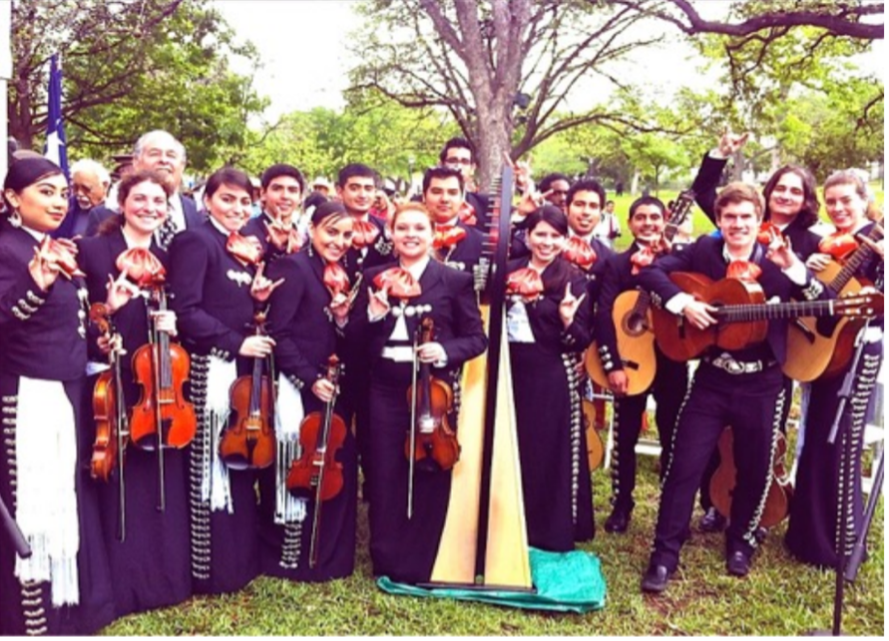
Ezekiel “Zeke” Castro once seemed destined for a life in classical music. Instead, he became “el rey”—“the king”—of mariachi in Texas.
At age nine, Zeke (b. 1939) was playing viola in a program for musically gifted children at the University of Texas at Austin (UT), near where he grew up. By age twenty-one, he was teaching college music courses and conducting orchestras at UT. Performances took him all over the country, from Washington, DC, to Yale University to Carnegie Hall. Prestigious schools from across the US, from Georgia to California, began recruiting him to teach in their music programs as well.
Then, Zeke heard a new kind of music that would change everything for him: mariachi.
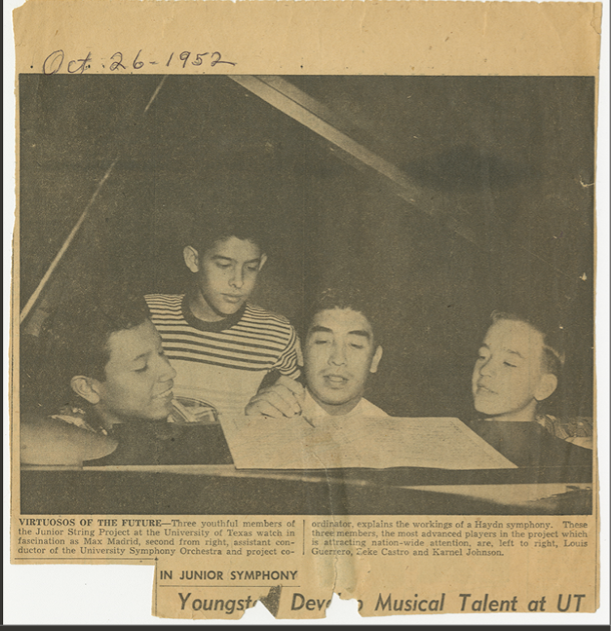
Zeke (second from left) at his music lessons at the University of Texas at Austin in 1952
Mariachi music entered Zeke’s life while he was living in California. In 1964, he and his family moved there for Zeke to study viola at the University of Southern California, where he attended graduate school. While studying, he played in several professional orchestras. He also taught music in public schools in San Jose, where the Castro family later moved.
Over the next ten years, the family built a new life in California. They formed close friendships and became active in a local Catholic church.
Then, in 1973, a friend from church invited Zeke to watch his band’s mariachi rehearsal.
What Zeke saw and heard that day wasn’t completely new to him. After all, he had grown up in a Hispanic household in Texas. His grandfather, Ezequiel Acevedo, played brass and string instruments in local bands. And he knew mariachi’s gleaming trajes (suits), its impassioned singing, its soaring violins and brass, and the deep pulse of its guitarrón.
Yet the music felt different this time. At once intrigued and intimated, Zeke wanted to learn more—and to play the music himself.
He joined the band.
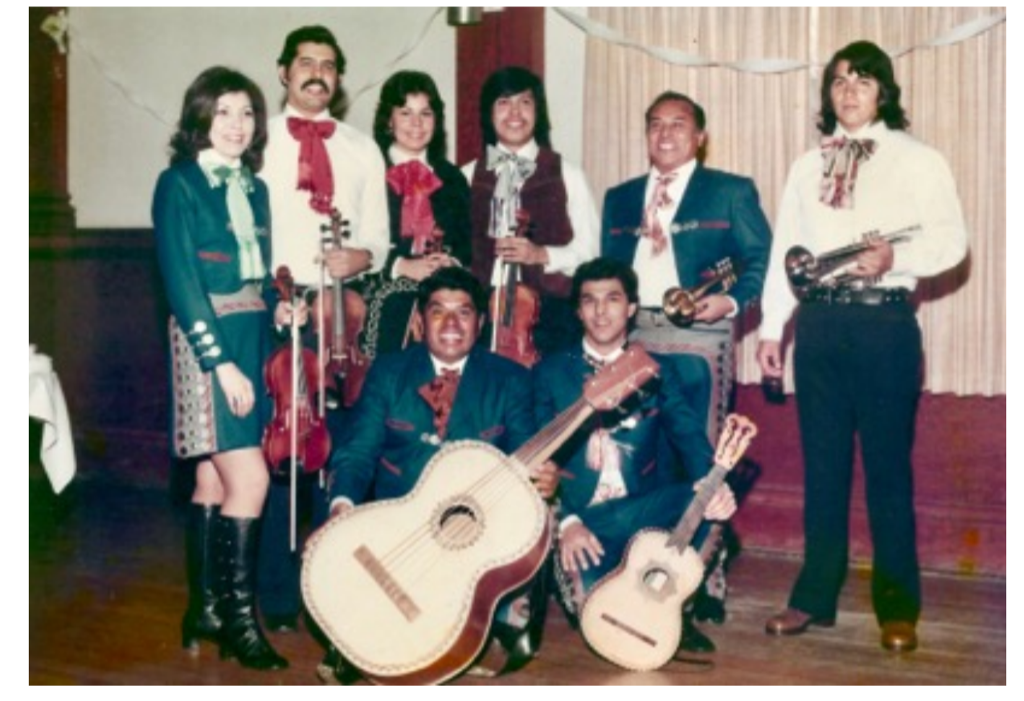
Zeke Castro and his San Jose mariachi group in the 1970s
One key challenge stood in Zeke’s way. In classical music, musicians usually follow written sheet music. But the mariachi group didn’t use any, playing entirely by ear. While daunting at first, Zeke soon caught on. It turned out that his skills in classical music transferred well to this new genre. He even learned to ask ¿En qué tono? (“In which key?”) to keep up with his ensemble without sheet music.
Little by little, Zeke found his place in the mariachi world. He began playing regularly with the San Jose group at local gigs. As more people heard him play, his reputation grew. Now, recognized for both his skills in classical music and mariachi, Zeke received new job offers. And they weren’t just for orchestra positions. They were for mariachi as well.
In 1979, the Austin Independent School District (AISD) in Texas recruited Zeke to start its first ever mariachi program. After twenty years in California, Zeke and his family returned home to Texas to embark on this new challenge.
At the time, very few schools in the US taught mariachi music. That meant Zeke had to create a new curriculum practically from scratch. Working with other intrepid teachers, such the local band director Dorothy Farmer, Zeke developed lessons and strategies to help young musicians adapt to the new genre.
The program was a success. Over the next thirty years, Zeke became a beloved teacher of both traditional orchestra and mariachi ensembles in the Austin area. Through music, he worked to give his students the same kind of encouragement and opportunity he received as a child, at the UT program for musically gifted children and elsewhere. Zeke was especially proud of how many of his students became professional mariachi musicians themselves. He would often run into former students performing at concerts and local restaurants around Austin.
Video of Zeke Castro and his wife Aly being serenaded by his former students, who now perform mariachi in Austin
Zeke’s mariachi ensembles traveled across the country, performing at many important events. They marched the Fourth of July Parade in Washington, DC. They performed at President Jimmy Carter’s National Salute to Congress at the White House. They even played at an official birthday celebration for Prince Charles of Britain during his visit to Austin and in the inauguration parade for George W. Bush when he became Texas governor.
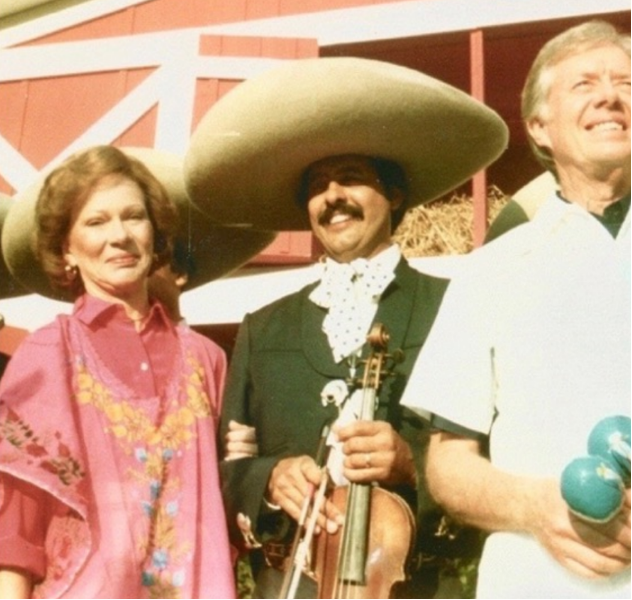
Zeke with President Jimmy Carter and First Lady Rosalynn Carter in 1980
In time, Zeke’s career came full circle. In 2011, the University of Texas at Austin—where his musical journey began—invited him to join their faculty. At the university’s prestigious Butler School of Music, Zeke served as a lecturer and director of the mariachi ensemble until his retirement in 2018.
Looking back today, it seems almost inconceivable that Zeke once hardly knew about mariachi. Over more than fifty years, he built a career that crisscrossed classical music and mariachi, inspiring hundreds of students along the way. His career shows how important music education can be—not only for an accomplished classical musician but for a mariachi pioneer. In the end, the music that once surprised him shaped his entire life. Zeke became what many now call him: “el rey”—“the king”—of mariachi in Texas.
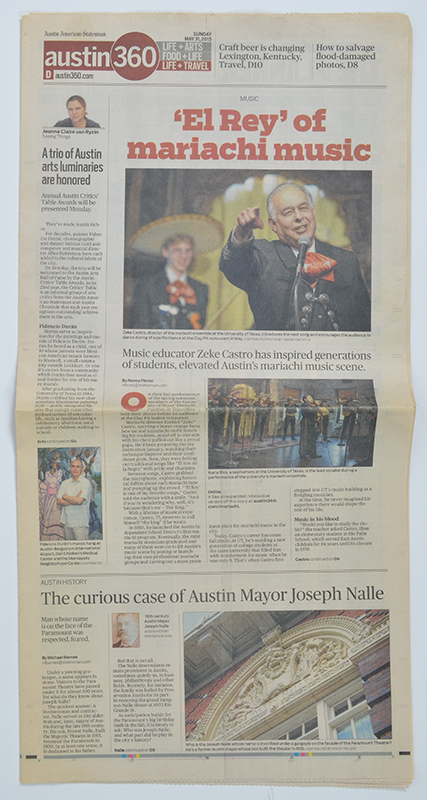
Zeke as “‘El Rey’ of Mariachi Music,” Austin360, March 15, 2015

Brittany Erwin is a historian of the early modern Spanish empire, and a curator of Spanish imperial and borderlands history. Her work explores community and identity, and the legacy of Spanish cultural traditions in the Americas.
Learn more about this topic:

Learn more about Zeke’s legacy in this interview with his former students
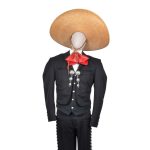
Learn more about Zeke’s traje (mariachi suit)
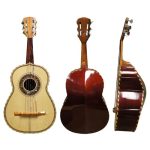
Learn more about the broader history of mariachi in Texas and Mexico