
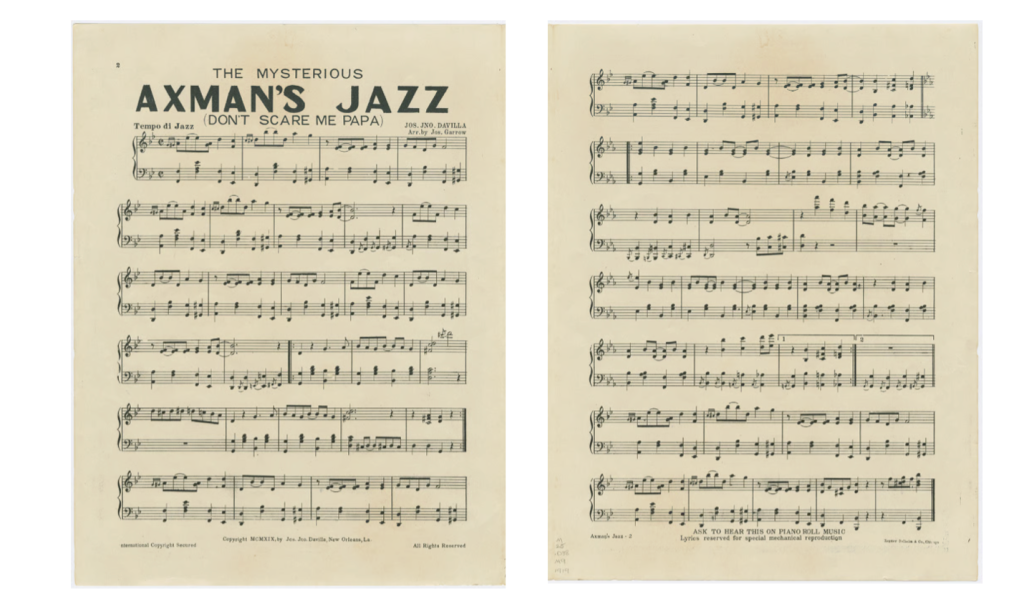
On March 13, 1919, a Thursday, an axe murderer who had been terrorizing New Orleans, known as “the Axman,” wrote a letter to the city’s newspaper, the Times Picayune. He claimed to be “a spirit and a fell demon [sic] from hottest hell” who would attack again the following Tuesday, March 18, at 12:15 a.m., adding another soul to his previous nine victims. For nearly a year, the Axman had been breaking into the homes of Italian and German Americans in the middle of the night, mauling sleeping people with an axe. After his assaults, he would disappear without a trace. Charitably, he let New Orleanians know there was one way to prevent his next midnight killing: Play jazz.
As he wrote, “I am very fond of jazz music and I swear by all the devils in the nether regions that every person shall be spared in whose house a jazz band is in full swing at the time I just mentioned.” In 1919, the popularity of jazz was growing, entering homes through the recorded sounds of white jazz bands like the Original Dixieland Jass Band, who first recorded in 1917. Black blues singers and jazz musicians would not be heard on record until Mamie Smith’s “Crazy Blues” of 1920. Those without a phonograph could hear live performances through touring ensembles, and those in cities could attend live performances in clubs. That Tuesday, March 18, the people of New Orleans flocked to jazz clubs, played records, or even performed jazz music in their homes to keep the Axman away.
The Axman did not kill that night.
Spared of the Axman’s fiendish doings, the people of New Orleans laughed at their own fearfulness. The cartoon below, for example, was published in the Times Picayune the morning after the threat. It shows a family frantically playing jazz to ward off the Axman. Grandma operates the player piano. Grandpa wails on the trombone. Father keeps the beat alongside his children, who wearily play the kazoo and snare drum. Mother keeps watch, hoping her family isn’t the next of the Axman’s victims. Each family member cries and sweats as they try their best to fend the Axman off.
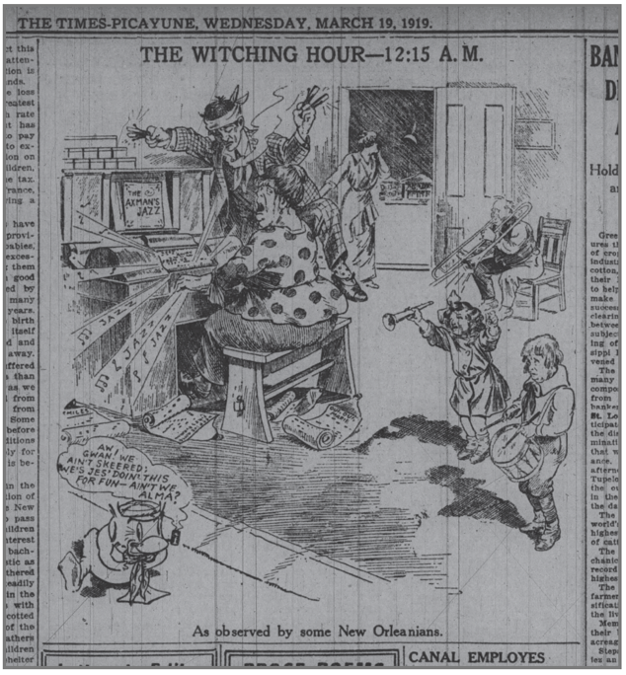
Cartoon published in the Times Picayune on Wednesday, March 19, 1919, page 8. Source: Newspapers.com.
The cartoon later became the sheet music cover for the ragtime piece “The Mysterious Axman’s Jazz (Don’t Scare Me Papa).” The composer, Joseph Davilla, was apparently inspired to capitalize on the Axman’s crimes and his threat to strike again. Advertisers even used the Axman’s stunt to sell Davilla’s sheet music—a mere two months later!
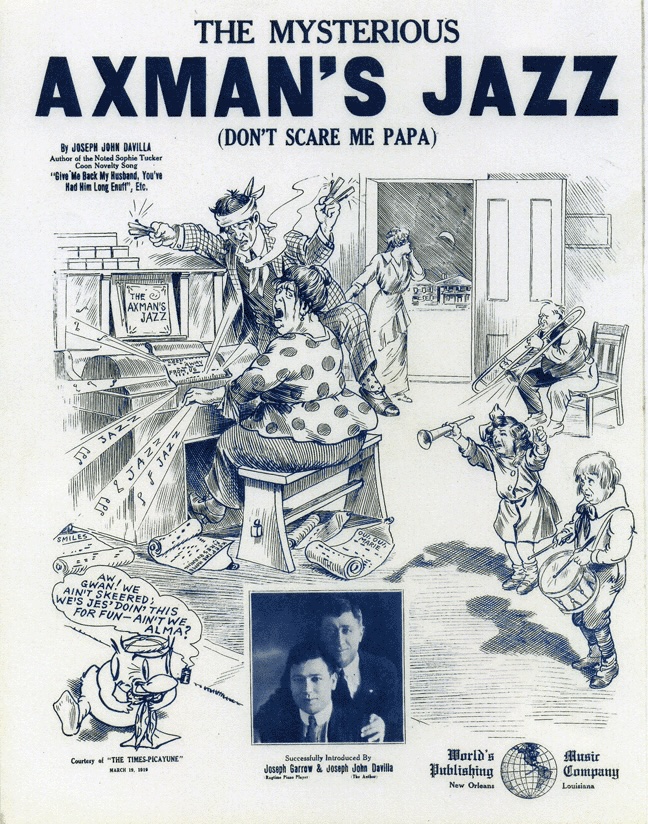
Sheet Music of Davilla’s “The Mysterious Axman’s Jazz (Don’t Scare Me Papa).” Source: Wikimedia Commons.
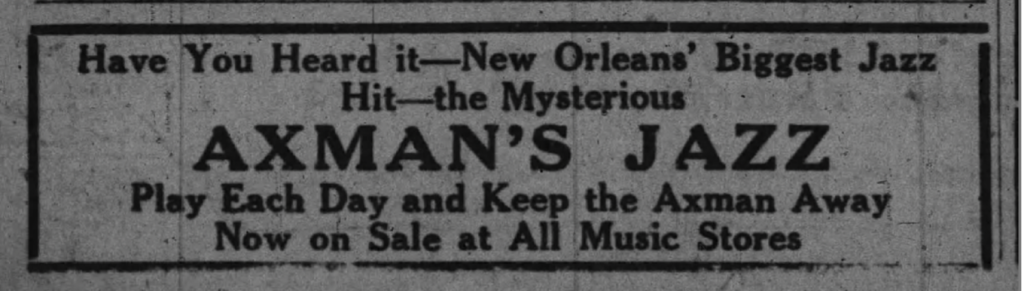
Advertisement from the Times Picayune on May 23, 1919, page 11. Source: Newspapers.com.
The Squirrel Nut Zippers, a present-day group that is inspired by the sound of Cab Calloway, covered “The Mysterious Axman’s Jazz (Don’t Scare Me Papa)” in 2018. In their rendition, they reimagine Davilla’s ragtime piano piece for a full band, including violin—a common jazz instrument in New Orleans at jazz’s birth. The driving beat evokes a sense of chaos from the night of the Axman’s planned attack as seen in the Times Picayune’s cartoon.
Squirrel Nut Zippers, “Axman Jazz (Don’t Scare Me Papa)” (2018)
Jazz, sadly, would not keep New Orleans safe for long. Later that year, the Axman assailed three more victims, each of whom survived their injuries. No one knows who the Axman was, but there are theories. Some amateur sleuths have speculated that the Axman was a guy named Mumfre or various henchmen of the Italian mafia. Regardless of his identity, the Axman linked criminality to jazz when the genre was in its infancy. He created a lasting connection between jazz, deviance, and corruption.
Many think that the “deviance” associated with jazz started in the early 1920s—when jazz became associated with Black bodies, sex, and flapper girls. Jazz’s supposed origins in the brothels of New Orleans supported this perception, which includes some instances when jazz was thought to be bad for public health, causing spasms and madness. The Axman serves as an earlier example of the association of jazz with deviance, an association which marked the public’s understanding of jazz for decades.

Dr. Hannah Krall is a musicologist interested in early jazz and improvisation, focusing on Creole of color clarinet players in New Orleans and the music of Duke Ellington. She has a BA in Music from Cornell University and a PhD in Musicology from Duke University. Currently, she is an Assistant Professor of Music and Program Coordinator for the music department at Shaw University, a Historically Black College/University in Raleigh, North Carolina, teaching courses in music theory, Black music history, and Western art music. Email: Hannah.krall@shawu.edu.
Learn more about this topic:

Learn more about the Axman.
Learn more about early jazz in New Orleans.

Learn more about jazz and deviance.